|
Escape Insights #15
How to Know You Can QuitThe 3 Numbers That Tell You When Work Becomes Optional
|
When I was 25 I had about $120,000 of debt, no plan, and no idea what a retirement account even was.
What I did have was a spreadsheet. And as I got organized and started tracking where every dollar went, that data turned into a life preserver, and it gave me a sense of control at a time when I badly needed one.
What it didn’t give me was an answer. I could tell you where the money was going, but I couldn’t tell you the one thing I actually wanted to know, which was: when can I safely quit my job?
So I did what most of us do and picked a number out of thin air. I told myself I’d be done by 45. It wasn’t based on math or science, it just sounded right, and for years it was the only light I had to sail toward.

It turns out I had plenty of company. In 2026, Americans told Northwestern Mutual they would need $1.46 million to retire comfortably, and that number moved $200,000 in just twelve months. Nobody’s life got $200,000 more expensive in a year. That’s what a goal does when it’s running on a feeling, and the trouble with a feeling is that it never goes away, and neither does the grind. It gets worse when you ask who has checked. According to the 2026 Retirement Confidence Survey, only 51% of workers say they’ve even tried to calculate how much they’ll need. Half of us are trading 90,000 hours of our lives for a finish line nobody has measured.
It took me years to tease the real math out of that spreadsheet, and last month I re-recorded the very first episode of the podcast to finally teach it properly. It has become the most popular episode I’ve put out. So this month I want to walk you through the same math in writing: the three numbers I used, how to calculate yours, and how to turn them into the one thing a feeling can never give you, which is a date.
Without a number, all you have is a feeling, and a feeling will never tell you when you can stop working.
The Number in Your Head Is a Feeling
When I ask people how they’re doing financially, the ones who track anything at all almost always give me their net worth. I’m a believer in tracking it, and I wrote a whole issue on why. Jack Allweil, a real estate investor with an actuarial background, made the best case for it when he came on the show: income only tells you where you are today, while net worth tells you the direction you’re heading. If it’s going up, you’re doing something right.
The problem is that knowing your direction isn’t the same as knowing when you’ve arrived. Net worth lumps together the house you live in, the 401(k) you can’t touch for decades, and the cash in your checking account, then hands you one big number that says nothing about whether you could cover next year without a paycheck. So people watch that number climb for years, and it still never tells them they’re done.
That’s how you end up like my friend Nik Johnson. Nik spent fifteen years rebuilding after a business loss took his retirement accounts with it, and in 2020 he figured he was on pace to be done at 50. Then he heard a podcast about the 4% rule, sat down and ran his numbers for the first time, and found out he was only a couple of years away. He had been doing the right things for fifteen years with no idea how close he was.
I’ve seen the same thing with people I’ve worked with. More than once I’ve sat down with someone who was sure they had another ten years of work ahead of them and wanted help speeding it up, and after we went through everything together I had to tell them they could have safely walked away years ago. That’s what happens when we operate without knowing what success looks like in numbers.
Net worth tells you which direction you’re heading, but it will never tell you the day you can stop working.
Why One Big Number Falls Short
The FIRE community, which stands for Financial Independence, Retire Early, does try to answer the question. Their version is called your FI number, and the rule of thumb is 25 times your yearly cost of living. If you want to live on $120,000 a year, the FI number says you need $3 million, and then you pull out 4% a year and hope that rule holds up against inflation and everything else life throws at you.
I wasn’t a FIRE person, and I don’t want to knock it, because a simple number beats no number. But even the FIRE folks I talk to don’t love it, and I think I know why. It treats life after work as one long stretch paid for by one pile of money, and if you plan to leave before your sixties, that’s a drastic oversimplification. There are really two stretches, with a bridge in between.
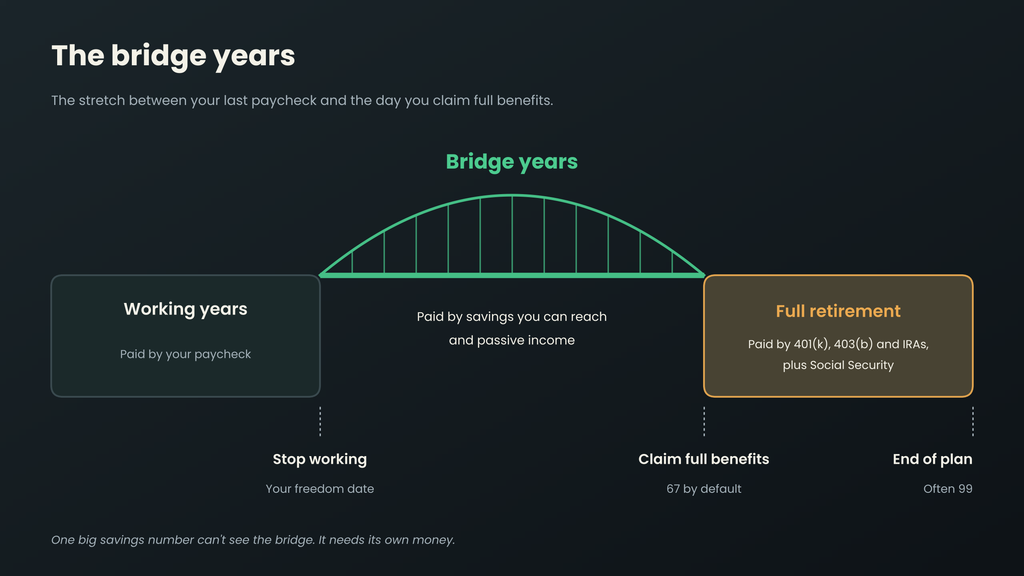
The bridge years run from the day you stop working to the day you claim full retirement benefits like Social Security. Your 401(k) and IRAs are generally off limits before 59½, and pulling from them early usually costs you a 10% penalty. I don’t know about you, but 10% is a nice return, and I see no reason to hand it over when it’s easy to avoid. So the bridge has to be built out of money you can reach, which means savings, brokerage accounts, any cash reserve without an age gate on it, and passive income.
Full retirement is everything after that, for the rest of your life, and it gets paid differently. That’s when the retirement accounts open up and Social Security kicks in.
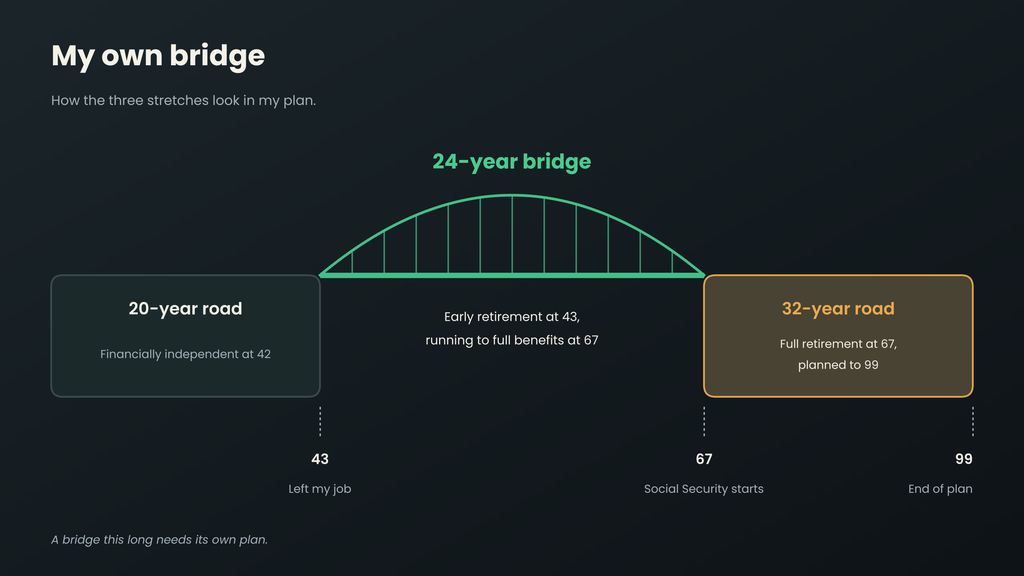
That’s my own plan. My program took almost 20 years. I hit financial independence at 42, left my job at 43, and I plan to delay Social Security until 67, which makes my bridge about 24 years long. A bridge that long needs its own money and its own math.
This is also where the big surprise is. Your freedom date isn’t gated on having a fully loaded retirement account. If the bridge is funded, and your retirement accounts are on a trajectory to be where they need to be by the time you reach them, you can go. You don’t have to wait for the slowest account to finish growing.
A single savings number can’t see the years between your last paycheck and the day your retirement accounts open.
Three Numbers Instead of One
So instead of one number, I use three.
The first is what you need saved in accounts you can reach to cross the bridge. The second is what you need in retirement accounts for the road on the other side. The third is the passive income you want coming in along the way. All three formulas are in the book and built into the free Smart Planner, so there’s no secret here, but I want to walk through them so you understand what’s driving your numbers when we run yours.
We need a few inputs first:
- Your current cost of living. This one isn’t a guess. Pull your last twelve months of bank and credit card statements and add up what you spent. For reference, the Bureau of Labor Statistics says the average American household spent $78,535 in 2024, but the average doesn’t matter. Yours does.
- Your target cost of living, once for the bridge years and once for full retirement. This is the fun part, because you’re designing the life you want and then putting a price tag on it. Will the mortgage be paid off? Will the kids be out of the house? What will you do for health insurance? Start from your baseline, add inflation and the life events you can see coming, and pick an average you can live with for each stretch.
- Your passive income rate, which is the share of your bridge costs you want covered by income instead of savings. This one is optional, and I’ll come back to it.
- Three ages: when you want to stop working, when you’ll claim full benefits (67 is the default for anyone born in 1960 or later), and how long to plan for. Advisors often plan to 99, to be safe.
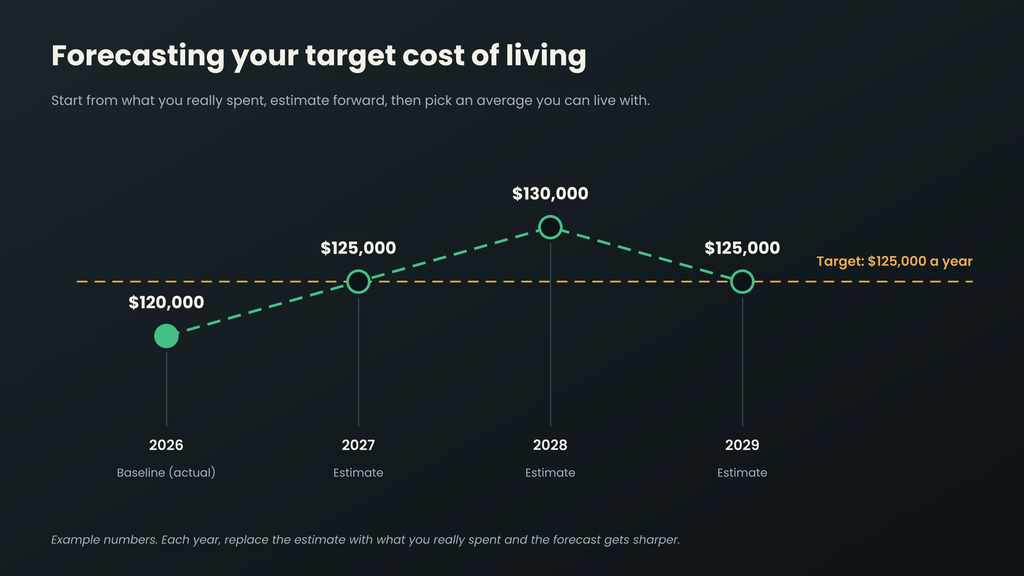
None of this has to be perfect. We’re all terrible at predicting the future, especially our own, and what I learned as my data grew into a plan is that you only have to be close. Every year you come back, replace the guess with what really happened, and the forecast gets a little sharper.
Now let’s run a simpler example all the way through. Say you plan to spend $60,000 a year in the bridge years and $50,000 a year in full retirement. You’ll work until 55, take Social Security at 67, and plan to 99, which gives you a 12-year bridge and 32 years on the other side. We’ll leave passive income at the default of 20%.
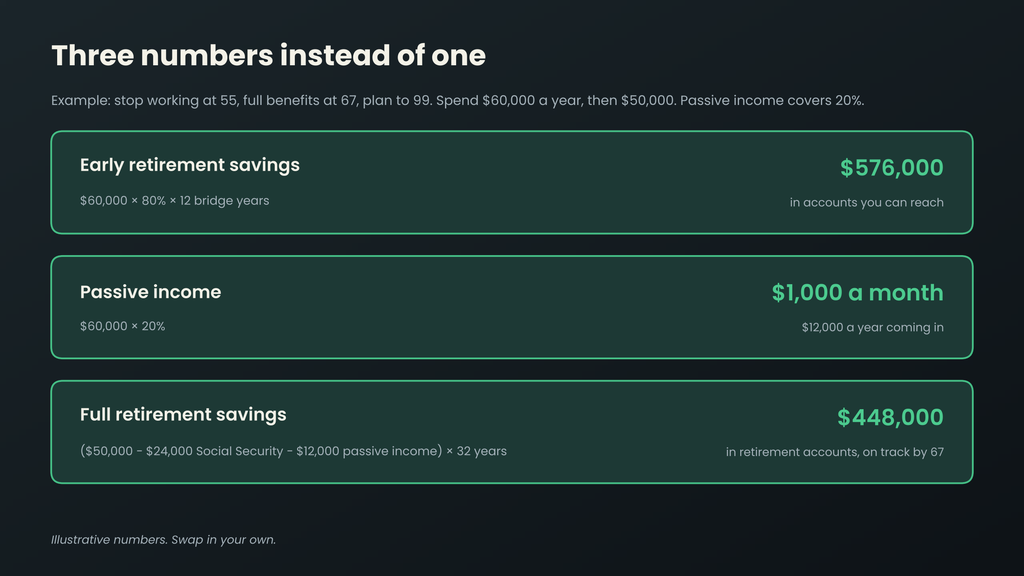
Early retirement savings: $60,000 a year, times the 80% you’re saving for, times 12 years, is $576,000 in accounts you can reach.
Passive income: 20% of $60,000 is $12,000 a year, or $1,000 a month.
Full retirement savings: say Social Security will pay you $24,000 a year (you can look up your own estimate at ssa.gov). Add the $12,000 of passive income and $36,000 of your $50,000 is already covered. The $14,000 that’s left, times 32 years, is $448,000 in retirement accounts.
Remember that the $448,000 doesn’t have to be sitting there the day you leave. In this example it has 12 more years to grow before you touch it, so what matters is that it’s on track. The $576,000 is the firm one, and I wouldn’t give up a W-2 paycheck until it’s in place.
What I love about this is that these are goals you can track. $576,000 in accessible accounts by 55 is specific, you can check it every month, and it has a date on it.
Every financial independence goal comes down to three things: what you spend, what covers it, and for how long.
The Lever Most People Never Pull
If those numbers look big to you, go back to the input I skipped, because passive income is a lever.
I’ll say it again: it’s optional. You can set it to zero, save for everything, and the math still works. But passive income is money that keeps coming in without you trading more hours for it, things like interest, dividends, rent, and royalties, and the more of your costs it covers, the less you have to save and the faster you get to your goal.
It also feels different. Watching income show up every month, the way a paycheck used to, feels a lot safer than watching a balance go down. After I talked with Connor Tyson, a Chartered Financial Consultant who builds his whole framework around recreating that paycheck, the way I put it was that a million dollars feels fragile, while six thousand dollars a month feels like a job that doesn’t require you to show up.
When I wrote the book I set the default at 20% because I think that’s conservative. Some of it happens almost by accident. A stock you bought pays a dividend, your emergency fund sits in a high-yield savings account, you move some cash into a CD, and each of those is an income stream whether you called it one or not. In our example, 20% is $1,000 a month, and that isn’t an impossible number to reach on interest alone.
Now watch what happens when we move the lever from 20% to 40%:
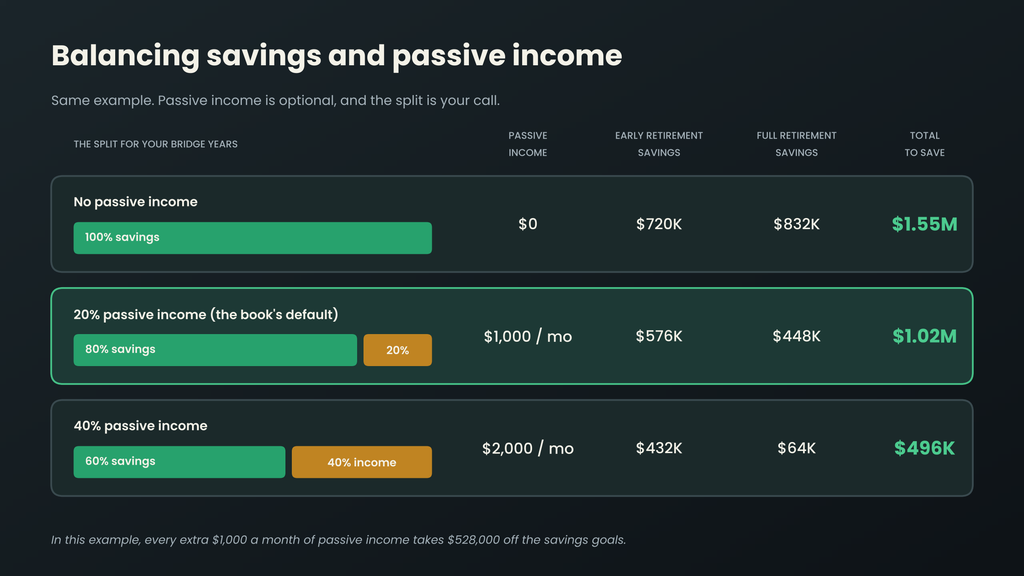
Early retirement savings drops from $576,000 to $432,000.
Full retirement savings drops from $448,000 to $64,000.
Passive income goes from $1,000 a month to $2,000 a month.
In this example, the savings goals fall from about $1 million to under $500,000 in exchange for another $1,000 a month in income. I know building that income is easier said than done. I have seven different income streams today, and it took me a while to figure them all out, but I promise I didn’t do anything special, and once they were running they kept compounding and now do a lot of the heavy lifting for me. If you don’t know where to start, chapter six of Escape The Clock lays the options out in tables, and my follow-up book is 100% focused on how to build passive income.
And if counting on income you haven’t built yet makes you nervous, leave it out. That’s the top row of the chart. Zero it out, and zero out Social Security too if you want. Your savings goals will jump, and it might push your date back a few years, but you’ll have bought yourself the biggest mitigation there is, which is never having to worry about a single dollar coming in.
Every dollar of income that keeps showing up on its own is a dollar you never have to pull from savings.
Your FI Number Is an Age
This last part is my favorite. In FIRE, your FI number is that big dollar amount. In Escape The Clock it’s an age, the earliest age when all three of your goals are met.
Finding it is the same forecasting we did for cost of living. You take your most recent real year, carry it forward one year at a time, and look down the list for the first year where your accessible savings have hit the goal, your passive income is where you need it, and your retirement accounts are on track for the day you’ll reach them. The Smart Planner does this with a 40-year forecast, so you can run your finger down the column until all three line up.
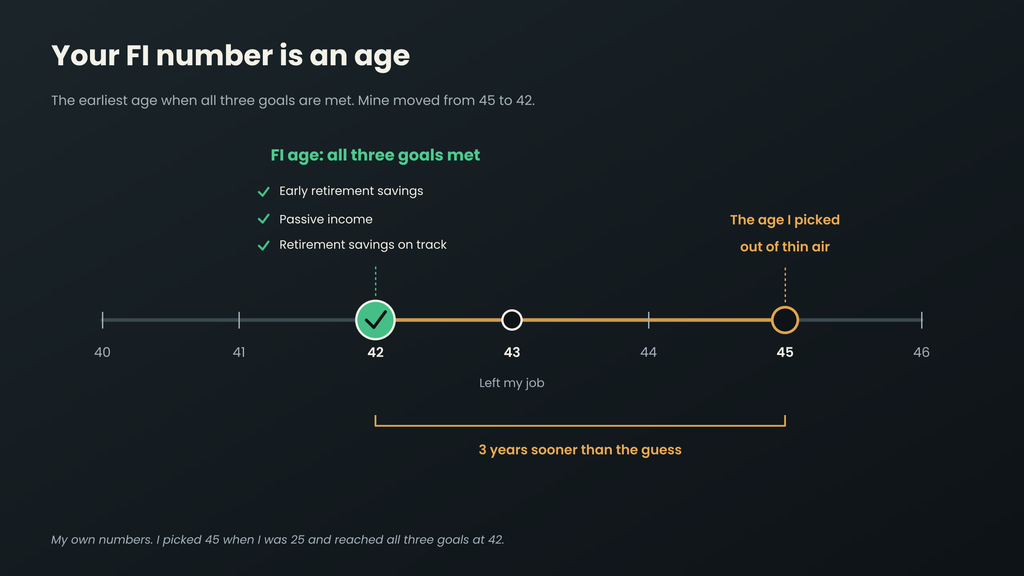
Mine started at 45, the number I’d picked out of thin air. Once I had real data in front of me, it was clear I wasn’t going to hit it unless I made some moves, so we made them, and each time I could see the date pull closer. I ended up hitting all three goals at 42, three years ahead of the 45 I’d picked.
You might wonder why one age matters so much. According to the Retirement Confidence Survey, workers expect to retire at a median age of 65, but retirees say they actually left at 62, and 46% of retirees left the workforce earlier than they planned. For a lot of people the age never gets picked. Something happens, they’re pushed out, and they have to figure out fast whether they have enough to last. Knowing your FI age means you know how far you are from ready, whoever ends up setting the date.
And if you do get to set it yourself, think about what that day is going to feel like.
The best birthday you will ever have is the one where work becomes optional.
Every Dollar Has a Price in Years
Once I had numbers I trusted, something changed that I didn’t see coming. I started to feel the pull of every financial decision I made.
Before, a big decision meant a pros and cons list, a few frustrating conversations, and hoping for the best. After, I could ask a better question. If we move, what does it do to my date? If something unexpected hits us, how far does it set us back? Sometimes the answer was three months, and three months is something you can make up. It works on the small stuff too. At a 4% withdrawal rate, every extra $100 a month you spend is another $30,000 you need saved before you can walk away.
To keep the numbers honest, I ran the whole thing like a program. The three goals are the milestones, the work to reach them becomes projects, and each project gets a to-do list you can burn down.
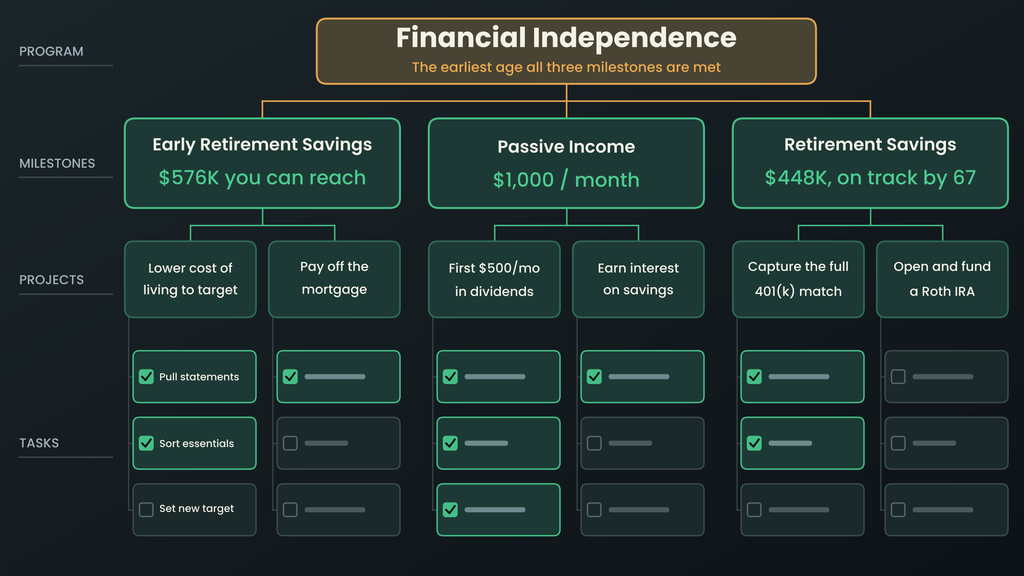
Paying off the mortgage is a project. So is building your first $500 a month in dividends, or getting your cost of living down to a new target. Date the far-off milestones loosely, with just a year, and tighten the close ones down to a month or even a day. Expect the numbers to move, because they will, and that’s okay.
It also changes the conversation when you ask for help. In that same survey, 45% of workers said they hope an advisor can help them figure out whether they’re saving enough. That means a lot of people are walking into an advisor’s office with empty hands and saying, help me figure it out. That’s an uncomfortable place to be, and it’s a place where you can get taken advantage of if you’re not careful. Walk in with your three goals and your forecast, and you’re the one leading the conversation. It’s called personal finance for a reason.
Once you know your numbers, a loan stops being a yes or a no and becomes a question of how many years it will cost you.
Learn More
I wish I’d had these numbers at 25. I would have avoided some very expensive mistakes, and that’s the whole reason I do this. You don’t have to be 25 to get something out of it, either. The prescribed career is 90,000 hours, and once you run your numbers, you may find your math says something very different.
Start with the episode this issue is built on, Buy Back Your Time: The Math Behind Financial Freedom, where I walk through all of it on screen.
Then go deeper with three conversations that back it up:
The Second Shot: How to Rebuild From Zero with Nik Johnson, host of Everyday Money Heroes, on rebuilding from zero and finding out how close he really was.
Permission to Spend with Connor Tyson, founder of Progress Solutions, on turning what you’ve built into a monthly paycheck.
Tracking for Transformation with Jack Allweil, on why tracking your numbers is where all of this starts.
Then do the one piece of work this issue asks for. Make the first project in your plan calculating your three numbers. The formulas are in the book at https://escapetheclock.com/book, and the free Smart Planner at https://escapetheclock.com/toolkit will run the forecast for you. When you have them, hit reply and tell me what number you were carrying around in your head before you did the math.
I spent years steering toward a number I’d made up. Go find your real one, and escape the clock!
About the Author

Daniel C. Rodgers, WMCP®, is the author of Escape The Clock, a multi-award-winning guide to financial independence, and Killswitch, a near-future science-fiction novel. He hosts the Escape The Clock podcast, now past 80 episodes.
“I wasn’t educated for this. I had no financial advantage. Quite the opposite, actually. I started with over $100k of debt and didn’t even know what a retirement account was. Two decades later, after a career in tech that took me from a small software shop in Ohio to senior roles at Microsoft and Google, I walked away at 43 with passive income covering our cost of living. Not because anything went unusually right, but because I built a plan and worked it for twenty years.”
These days he teaches personal finance as a volunteer, takes free one-on-one calls with anyone who asks, writes fiction, fosters dogs, and shoots billiards in the American Pool Association.
Learn more and connect with Daniel at www.escapetheclock.com.